


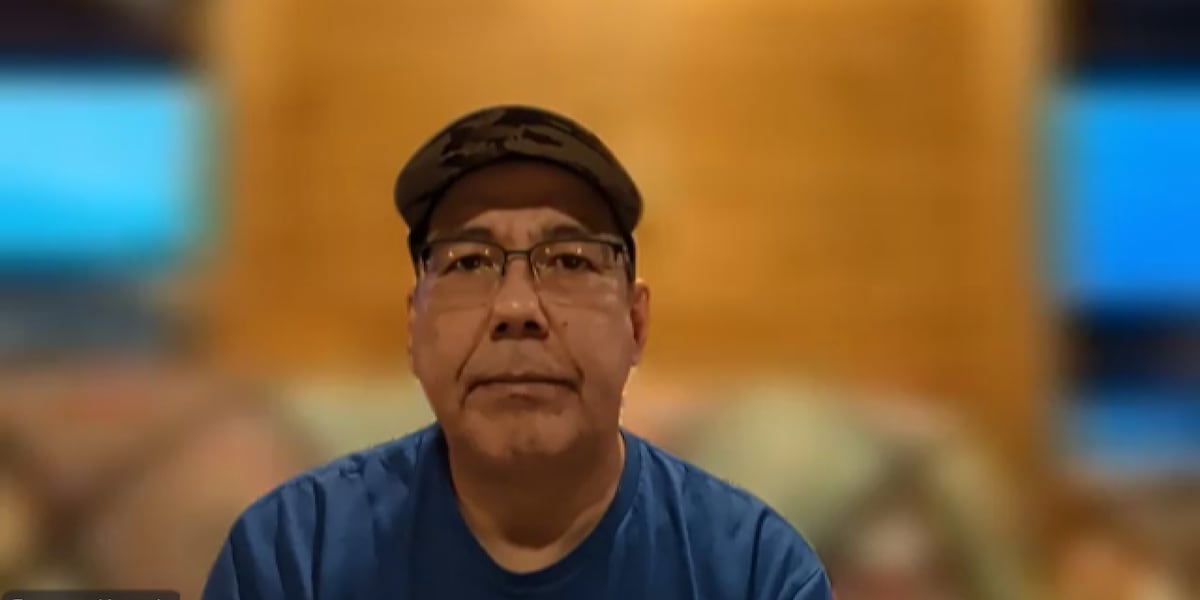
FAIRBANKS, Alaska (KTUU) — For years, George Koontz watched what he says was his son Brian’s mental health decline. He sent incoherent text messages, refused to take medication and, George says, had schizophrenia that, without treatment, made it difficult for him to distinguish reality.
At the same time, his 87-year-old mother, Velma, was fading from dementia, confined to a wheelchair and under hospice care.
On Jan. 20, Brian was charged with shooting his grandmother in the back of the head. According to charging documents, he told police he wanted her to “go peacefully” — comparing it to “pulling the plug.” George believes his son, who is charged with the killing, saw it as an act of mercy. He has pleaded not guilty.
In his first interview, George spoke with Alaska’s News Source about what happened to his family — and his call for changes to Alaska’s mental health system.
Who Velma Koontz Was
To understand what happened fully, it starts first by understanding the woman at its center. George said she was not simply a victim; she was a pillar of her family and community.
“She’s an amazing woman,” he said, describing his mother with deep affection and respect. “She was born in a camp outside of my home village of Savoonga.”
Velma grew up in a different era of Alaska—before statehood. Her father was a noted trapper, and she inherited his adventurous spirit.
“She [was] always … a go getter and went outside several times for training and eventually met my dad, who was a biologist for fish and game, studying walrus on the island, which happens to be the walrus capital of Alaska or the world,” George explained.
But Velma’s greatest role, George said, was as a staunch supporter of her children and grandchildren, creating structure and a nurturing environment as a “no-nonsense woman.”
Her influence extended through her family. George credits her with being a major reason his other sons became successful adults. In her community, Velma was known for her warmth and humor. George recalled friends described her as “a really jolly, mirthful person” and “the light in the get-togethers that they would have.”
The Toll of Dementia
But time proved to be Velma’s cruelest adversary. Starting about a decade before her death, George noticed what he described as troubling changes in his mother’s memory.
“We started noticing that she had trouble remembering stuff,” he explained. “It’s kind of like, if you use the metaphor of a candle, her candle started getting dimmer and dimmer with the passing years.”
The disease progressed relentlessly. The period in which she could remember, according to George, grew shorter. Towards the end, she struggled with remembering how to swallow, along with other body functions.
In October 2025, Velma’s health took a sharp turn. George said it “took the wind out of her sails.” After that, “it appeared like she at least partially left in spirit.”
During her last two months, Velma was also battling intestinal cancer. George and his wife cared for her, with support from local hospice and nonprofit organizations. Despite her decline, George said she still recognized him. “She remembered me to the end,” he said.
Brian’s Struggle and Warning Signs
Velma’s death came after a much longer struggle within the family—one George said centered on his son Brian Davenport and his battle with what George says was schizophrenia.
George says he gained custody of Brian when his son was 11. Brian started exhibiting schizophrenia symptoms as early as age 18, according to George. By then, Brian had moved out of his house. By his early 20s, “it was obvious that something was going on with him mentally,” George said.
As Brian’s mental state deteriorated, George allowed him to stay at his house temporarily. But faced with a difficult choice—risking his younger children’s safety or removing his son—George made what he believed was the responsible decision: “I had him leave.”
Brian ended up living with George’s parents starting in the fall of 2025, according to George.
In the days before what happened, George noticed Brian’s mental state was deteriorating rapidly. “He’d done it on and off incoherent texts and stuff, basically babbling,” he recounted.
George finally blocked his son, only for Brian to redirect his text messages to George’s father, “sending him blocks and blocks of texts that really didn’t make any sense,” he said.
But George had no indication his son would become violent. “I never knew that he was violent. Otherwise, I’d maybe have done things differently, but it’s too late for that,” he said.
The Tragedy and Its Aftermath
According to charging documents, around 3:45 p.m. on Monday, Jan. 20, 2026, Fairbanks police received reports of a shooting on 22nd Avenue. Officers found Velma dead in her wheelchair with a gunshot wound to the back of her head.
Less than an hour before the shooting, Brian had called 911, providing an address but remaining unresponsive to the dispatcher’s prompts. When police found him pacing on the side of the road displaying “careless behavior,” they brought him to Fairbanks Memorial Hospital for Title 47.
When police learned of Velma’s death, they questioned Brian. He allegedly told an officer: “I killed someone.”
According to charging documents, Brian allegedly stole the gun from his grandfather Keith Koontz’s nightstand. He told officers he had planned to kill someone else but changed his mind.
When asked why he killed his grandmother, he compared it to “pulling the plug,” saying he wanted her to “go peacefully” and didn’t want her to worry about “the legacy she left behind.”
George believes in the middle of a mental health crisis his son became fixated on his grandmother’s decline. When asked if Brian saw this as a mercy killing, he responded: “Absolutely. Absolutely.”
“Because he couldn’t think straight, maybe that became just prominent in his life, the suffering of his grandmother, who always stood up for him and encouraged him to do his best,” the father added. “I don’t think he was enough there to make rational decisions.”
After learning of his mother’s death, George said he was shocked—and then felt something unexpected.
“I think I almost went catatonic and I was just shocked that would happen,” he recalled. “I also realized that my mom wasn’t suffering because I’d wake up every day wondering if it was her last day … And I was actually kind of relieved too that she wouldn’t be suffering anymore.”
At his son’s initial court appearance in January, George testified that Brian was “a danger to the public.” Brian remains held on $5 million bail. He is presumed innocent until proven guilty. His attorney, Patrick Roach, entered a not guilty plea on Feb. 4. Brian did not appear at the hearing.
George said he has not been able to speak to his son since his arrest, but plans to visit him soon at the Fairbanks Correctional Center. Brian’s next court hearing is scheduled for Feb. 26.
A Call for Change
According to George, Brian had been placed in group homes twice, which provided crucial structure and medication enforcement. But he didn’t stay in them, and without that structure, his condition worsened.
George sees what happened to his family as part of Alaska’s broader mental health crisis. He pointed to what he sees as a missed opportunity: opening mining on Alaska Mental Health Trust Fund lands near Esther, with proceeds funding mental health services.
“They really didn’t want to have any prospecting and mining next to it, but you have to juggle what’s in the public’s best interest. I mean, we have way too many murders and homelessness in the state, and the Alaska Mental Health Trust Fund land is supposed to help pay for it,” George said.
Alaska’s News Source reached out to the Alaska Mental Health Trust Authority for comment, but did not receive a response by publication time.
George says the gun was stored in a locked bedroom and Brian broke into it to access the weapon, though this detail about the bedroom being locked is not mentioned in court documents.
Despite this, George advocates for “red flag laws” — also known as extreme risk protection orders — which allow families to petition courts to temporarily remove firearms from people in mental health crisis. Alaska does not currently have such a law.
“I think we should have red flag laws and maybe if they don’t want the public flagging them, at least make the family that knows individuals be able to flag people with mental illness so that at least firearms won’t be a part of the problem,” George said.
Drawing on his experience as a former village public safety officer, George advocates for treatment over incarceration for people with severe mental illness.
“I look at it as a societal view — it costs us, what, $40,000 a year to house somebody in jail … I think it’s cheaper to treat that behavior than it is to put them away at our expense for decades,” he said. “I think [Brian] would be best served at a mental institution where there would be some hope of him salvaging his life … with more focused care on him learning to understand his disease and manage it.”
George reflected on the values that defined his mother’s life and upbringing in Yupik culture: “We do have freedom to do what we want, but it’s based on community responsibility … That’s what’s missing in Alaska, is there’s too many individuals [who] want to get the most of what they can out of the state.”
Legacy
George and his siblings are working to ensure Velma is remembered for who she was. “She was a good, upstanding, law-abiding mother. I think mothers don’t get enough status in our society,” he said.
The family rented out the JP Jones Center in South Fairbanks to celebrate Velma’s life. Since her passing, they have been sharing meals together, taking drives, planning fishing trips—the activities that have always connected them to one another and to the land.
Velma’s funeral will take place in the summer at a Baha’i cemetery outside of Fairbanks, reflecting her religious faith.
George’s final message is a call to unity: “I think the village, Bush, Alaska gets a lot of hate unnecessarily, but I think we need to view the state as a village … the advice my mother gave us as her children applies to everybody in this world, love one another.”
For Velma Koontz — the woman born in a camp, who became a pillar of her family, who even in her final years remembered her son — that message endures.
If you or someone you know is experiencing a mental health crisis, call or text 988 for free, confidential support 24/7.
See a spelling or grammar error? Report it to web@ktuu.com
Copyright 2026 KTUU. All rights reserved.
link