
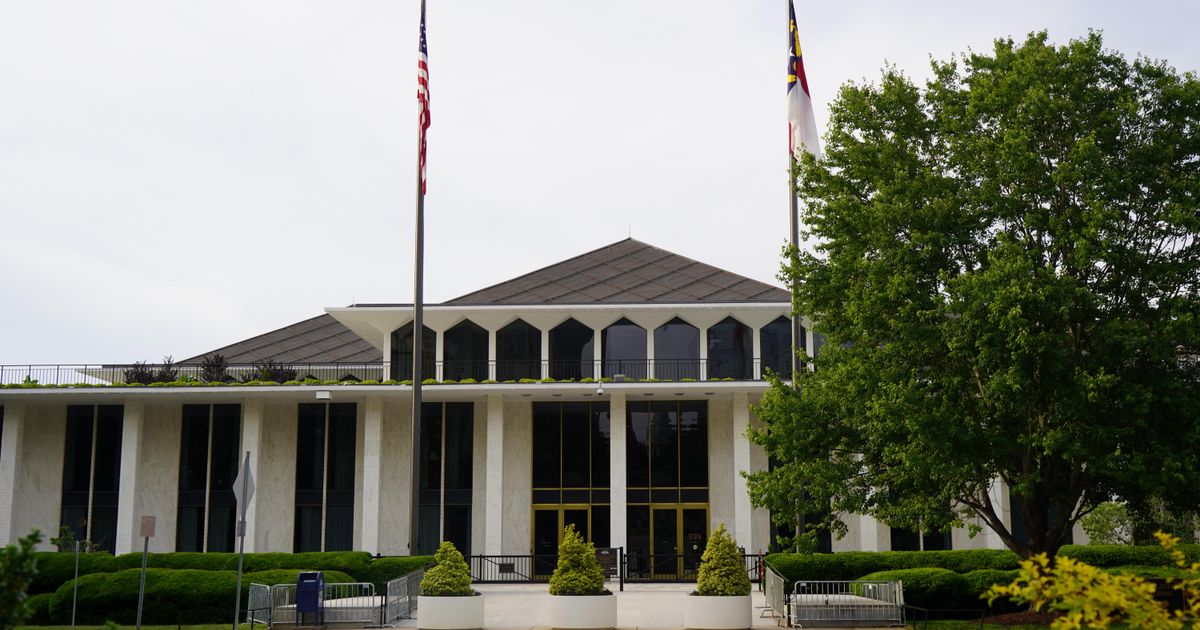
A new state budget — and with it funding for Medicaid, Helene recovery, raises for hundreds of thousands of state workers and more — is still months away, as North Carolina continues forging ahead as the only state in the country without a new, comprehensive budget in place.
State lawmakers could return to session any time they want. But they’re highly unlikely to do so until after the March primary elections are over, according to multiple lawmakers and staff members.
Holding up the budget is an intra-party debate among Republicans over tax policy. Republicans control both chambers of the legislature, but GOP leaders in the state House and Senate have strong disagreements over whether to continue to reduce income tax rates as their own economists warn of an impending deficit.
And since taxes make up the vast majority of state revenue, there’s no way to know how much money the state might have to spend until that fight over tax policy is resolved.
Democratic Gov. Josh Stein has repeatedly criticized lawmakers for not passing a budget. North Carolina already pays teachers, state troopers and prison workers less than almost every other state in the country, he said.
A Stein spokesperson pointed to the website ZipRecruiter, which shows the average North Carolina State Highway Patrol officer is paid nearly $10,000 less than the national average. Likewise, entry-level prison workers would need more than a $14,500 raise to hit the national average for others in the same position, according to the state prison system. But instead, no new budget means no new raises for them and other state employees.
That could continue to strain state agencies, which have struggled to recruit and retain workers.
“Our public servants are not adequately compensated for the value they provide to all of us,” Stein said Thursday. “The idea that when we’re not paying enough to have a mental health care system that keeps us all safe, they haven’t fully funded Medicaid yet … just doesn’t make sense to me.”
The John Locke Foundation, a conservative think tank in Raleigh, wrote in November that the budget standoff is “a severe failure of governance” that’s derailing important policy efforts in addition to the lack of raises.
“A failure of this magnitude doesn’t just delay spending adjustments; it blocks policies that both chambers broadly support,” the group wrote. “This year’s stalemate sidelined several shared priorities that should have been straightforward wins.”
Spokespeople for House and Senate GOP leaders didn’t respond to requests for comment on whether their top budget writers have been meeting recently to try to break through their impasse, or if they have any plans to do so in the next month or two before session starts.
The lack of information is frustrating even to some Republican lawmakers, particularly newer members without much sway over the secretive budget talks. Rep. Brian Echevarria, R-Cabarrus, shared those frustrations in a recent newsletter to supporters.
“When you get to Raleigh, you learn that a small group of folks control the state budget,” he wrote. “It is actually pretty wild. Everyone knows they exist; no one knows exactly what they are talking about or when they meet.”
When the legislature does return to session to try again, likely sometime in late March or early April, Stein is expected to pressure them to quickly act on Medicaid funding — even if it needs to be done outside the normal budget process.
Because there’s no new budget, Medicaid is set to run out of money sometime in March or April, state health officials say. It’s possible that happens right around the time lawmakers return to Raleigh, or even before.
If that happens, the more than 3 million North Carolinians on Medicaid could lose the ability to go to the doctor, fill prescriptions or continue with treatments, in-home care or other health care they receive through Medicaid.
Stein tried several strategies in 2025 to address the problem, but none worked.
He reduced the amount of money Medicaid paid hospitals and other providers to treat patients, but he quickly lost in court after health care businesses and Medicaid families sued to stop that strategy. He ordered the legislature back to Raleigh for a special session on Medicaid funding in November. Although the state constitution gives the governor the power to call special sessions, only Democrats showed up. Republicans ignored Stein’s order to return and deal with Medicaid, saying they’d get around to it in 2026.
“The legislature will be back this spring with more than enough time to add additional funds if needed,” House Speaker Destin Hall said at the time.
Other priorities
While Medicaid and a new budget will be at the top of the agenda for the short session starting this spring, they won’t be the only topics lawmakers want to address.
- Efforts to change election laws are likely to see a renewed push ahead of this year’s hotly contested midterm elections. House Republicans began pushing a slew of possible changes over the summer; those ideas fizzled out at the time but could be revisited this year.
- House Republicans are making property tax reform a top priority in committee meetings being held before the full 2026 session, but there’s no indication yet that the Senate is interested in touching what could end up becoming a highly contentious fight between state and local leaders.
- Helene funding is also expected to be on the agenda in 2026 and for years to come. State lawmakers have grappled with competing strategies for relief, such as whether to create grants for small businesses struggling after the storm, or how much money to pump into local cities and counties from state funds. Complicating matters, federal funding from the Trump administration has been significantly lower than expected.
- The annual farm bill also sputtered to a halt last year, in the face of bipartisan opposition against suggestions to ban raw milk and to stop people from being allowed to sue pesticide companies for harming human health. German life sciences company Bayer has paid out more than $10 billion as of 2025 to settle claims that its weed-killer Roundup caused cancer.
Those topics could return in 2026, as could renewed efforts to strengthen the state’s involuntary commitment rules. Two recent killings in Charlotte and Raleigh, each of which police say were committed at random by homeless people with lengthy mental health and criminal histories, have spurred popular outcry about whether the state’s criminal justice and health care systems are properly dealing with the mentally ill.
Two House budget writers recently told WRAL News they want to see more funding for mental health in the new state budget. Lawmakers are also separately wrangling with hospitals and local sheriffs to determine who should be in charge of holding alleged criminals with mental health problems.
“We can require judges to make some decisions that will make our community safer,” Rep. Erin Paré, R-Wake, told WRAL News. “We can be tougher on crime. But we also need to address mental health — and that does require funding, and I’m in favor of that as a budget writer.”
But a full picture of what lawmakers plan to tackle in 2026 is difficult to put together.
In the waning months of 2025, as it became increasingly clear that no budget deal was coming, the two chambers increasingly engaged in the legislative version of hostage-taking. Bills that passed one chamber would often be blocked from advancing in the other, no matter how much support they had.
It’s a common negotiating tactic that both chambers of the legislature use: If the House has a few big priorities that aren’t as big of a deal to leaders in the Senate, then the Senate can say they’ll let those ideas pass but only if they get certain concessions in the budget, and vice-versa.
So with that context, it’s perhaps no surprise that top lawmakers are being tight-lipped about what they want to focus on in 2026.
Over the past two weeks, WRAL News reached out to more than a dozen Republicans who chair various legislative committees to ask if they could provide details on any bills or topics they’re hoping to tackle this spring. Their areas of expertise range from Helene relief to education, election law, health care, public safety and more. Two of them said nothing in particular came to mind; none of the rest responded at all.
Budget tax fight
Last year, a team of economists from the Republican-controlled legislature and the Democratic governor’s office published a joint report that concluded the state has been cutting income taxes too aggressively and will hit a deficit as soon as this year, unless changes are made.
Hall believes the economic forecast. He and fellow House Republicans have proposed mostly keeping taxes as they are now, and instituting stronger safeguards to stop planned future tax cuts if state revenues drop. They’ve also proposed some smaller tax breaks, such as reinstating the sales tax holiday for back-to-school shopping that Republicans got rid of in 2014 to help pay for income tax cuts.
Senate leader Phil Berger has said he doesn’t believe that economic forecast. He wants to ramp up cuts to the income tax rate, making them even more aggressive than the already-planned cuts the experts predicted would soon lead to a deficit.
In addition to the question of whether or not the analysts are correct that the state is heading toward a deficit, there’s also a bigger question of who the legislature wants to help with new tax policy. The House strategy would be more weighted toward low-income and middle class families, while the Senate strategy would be more beneficial to wealthy people and businesses.
Democrats don’t hold enough seats in the state legislature to give Stein enough leverage to credibly threaten vetoing the state budget unless he gets certain concessions. So he has instead sided with the House, which has more populist and less aggressive tax cuts — and higher raises for state workers — than the Senate plan. Stein said Thursday he remains concerned about the state’s ability to keep paying the bills unless GOP leaders consider their tax policy.
“We need to have a certain amount of revenue just to keep where we are,” he said. “And there are pre-programmed tax cuts, in law, that will ensure that we will be in a worse position in two years — to the tune of $2.3 billion — than we are today.”
link