
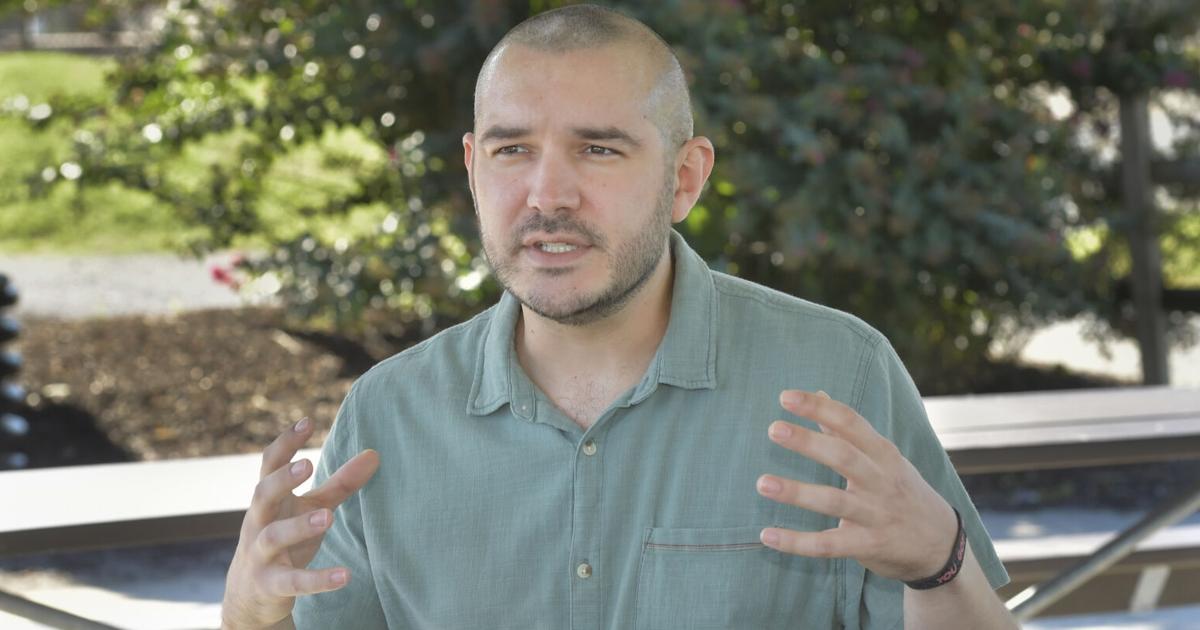
Editor’s note: This story was updated to reflect that Tanner McIntosh now plans to undergo 12 total chemotherapy cycles.
The 2023 Thundering Pickle Turkey Trot wasn’t Tanner McIntosh’s first 5K.
That Thanksgiving morning in York County, he expected to feel sore, raise some money for the Dillsburg Area Soccer Club and move on his with life. But McIntosh felt a searing pain in the lower right side of his back. He finished the race and chalked it up to soreness, getting older.
McIntosh, now 37 and living in Lancaster, didn’t consider that he could have a brain tumor. Before taking on his current job, he handled budgets for clinical trials on oncology, the study of tumors. The issue was familiar, not personal.
His friends didn’t consider it either, including Laura Hartnett of Philadelphia. She has known McIntosh for more than a decade, since they were counselors at The Renfrew Center, an eating disorder clinic in Philadelphia.
“I figured it was just time to rearrange his stretching routine,” Hartnett said by email. “I think I was too naïve to think that one of my friends (in their 30s at that) could be dealing with a major health scare.”
That winter, McIntosh went skiing in Maine. The feeling returned, worse this time. His primary care doctor recommended physical therapy, which he tried without success.
“I don’t even know how to explain it,” McIntosh said. “It was just so overwhelming and so not normal.”
In spring 2024, he started to experience back spasms. They progressed to limit his ability to move and talk for up to 30 seconds. He could only form words with a lot of concentration. His doctor ordered a brain MRI.
The result showed a mass next to his primary motor cortex, the part of his brain responsible for voluntary movements. It also meant McIntosh was eligible for a special procedure at Penn Medicine Lancaster General Health: the hospital’s first awake craniotomy.
READ: LCBC bus crash survivor, Elizabethtown native pursues a medical career following recovery
Awake craniotomies
Penn Medicine, which parents a dozen hospitals and medical centers in Pennsylvania, performs hundreds of awake craniotomies every year, typically with the goal of removing brain tumors.
“Most of the brain is actually pretty amenable to surgical intervention because it participates in part of a network,” said Dr. Eric Hintz, a neurosurgeon at LGH. He compared removing a piece of the brain to taking out a single power line in Lancaster city.
But when tumors encroach on territory vital for talking, moving, seeing or other important bodily functions, surgeons may require an awake patient.
During awake craniotomies, doctors begin the surgery with a patient on a local anesthetic and remove a section of the skull, commonly called a bone flap, to access the brain. As the procedure goes forward, they wake up the patient to test their ability to talk and move as they stimulate various parts of the brain. If a person can hold a conversation or perform certain movements, the professionals know they’re on the right track.
Hintz had performed awake craniotomies elsewhere but never in Lancaster County. That is, until McIntosh’s primary care doctor referred him to Hintz’ team in summer 2024.
READ: Thrivers breast cancer support group unites Lancaster County real estate agents
‘A good candidate’
Not everyone fits the bill for an awake craniotomy, even if their tumor grows in a precarious location. McIntosh didn’t have this problem.
“Kind of all aspects of Tanner made him a good candidate,” Hintz said.
McIntosh was young and relaxed, and stood to benefit from removing as much of the tumor as possible. Anesthesiologists, who protect the airway during surgery, can’t insert a tube in the patient’s throat as they normally do. Patients need to breathe on their own, which requires some level of physical fitness.
Plus, the candidate needs to be comfortable with having a surgeon remove a section of their skull and prod around in their brain while conscious.
“There are people who are so aggrieved at the idea that you can’t proceed,” Hintz said. He has had patients in the past decline the procedure for that reason.
McIntosh, though, said he was willing. He had worked with Penn Medicine before, witnessing surgeries as a financial coordinator at the Hospital of the University of Pennsylvania. He trusted the doctors. He didn’t want to wait for things to get worse, or for biopsy results to reveal that he might need surgery anyway.
“I didn’t have any hesitations about going through with the surgery, so ultimately, we just went with that,” McIntosh said. “Might as well.”
Joey Fellenbaum, McIntosh’s partner, was present at the appointment at the Ann. B. Barshinger Cancer Institute when McIntosh’s care team pitched an awake craniotomy as an option. Even though McIntosh didn’t hesitate, Fellenbaum said he was in complete shock.
“I have never heard of that being a possibility,” Fellenbaum said by email.
To prepare, McIntosh met with Dr. Jesse Main, a neuropsychologist at LGH. When something goes wrong with the brain, Main helps patients understand how it may impact their behavior and emotions.
Main set expectations for McIntosh about what an operating room looks like and the types of things he might hear during surgery. They practiced the speech and motor exercises Hintz and Main could ask Tanner to do during surgery to check his brain function, including basic finger movements without contracting his fist. In other exercises, he acted like he was using a screwdriver, and flexed his arms and legs.
Meanwhile, Hintz prepared by studying McIntosh’s brain so he could go in with the best understanding of the tumor as possible. That knowledge was especially important because once Hintz started prodding around during surgery, he wouldn’t be able to rely on the untouched imagery he had from the scans. The brain, he said, isn’t color-coded.
“A tumor itself looks very similar to the surrounding brain,” Hintz said. “It gets to that point that you’re relying on that clinical judgment.”
The surgery
McIntosh doesn’t remember much from the surgery in December, even though he was awake for half of it. He recalls mostly sounds. It felt ethereal, he said, like a dream.
McIntosh and his parents checked in at the hospital by 5:27 a.m. Laura McIntosh, his mother, said she felt a bit freaked out by the procedure, since she didn’t know anyone else who had undergone it. McIntosh is her first born of four and was “the easiest to raise,” she said by email.
LGH staff moved McIntosh to the operating room three hours later. He cracked jokes, met the anesthesiology team and learned more about the ideal outcome. He remembers it seeming like a normal, average day for staff. They administered local anesthesia, putting him in a stupor.
With McIntosh’s scalp anesthetized, Hintz placed his head in a clamp with three pins resting against his skull to keep McIntosh’s brain from moving. The neurosurgery team used computer software to align scans of the brain and tumor with McIntosh’s actual head. Then, Hintz and a neurosurgeon from Philadelphia drilled into the skull, which Hintz said is a “loud, stimulating experience.”
Then McIntosh remembers waking up. He heard clicks, people talking, Hintz poking around. He described “sloshing.”
“It was pretty gnarly,” McIntosh said.
Main sat at McIntosh’s side, behind the curtain, to test the speech and motor skills they had worked on together. The tumor was on the left side of the brain, which impacts the right side of the body, so staff set up the operating room to allow Main to do his work from McIntosh’s right.
“Dr. Main, his voice is like a soft, velvety butter,” McIntosh said. “He just has this way of speaking, you couldn’t be stressed if you wanted to be.”
As Hintz stimulated the tissue around the tumor with electrical pulses, doctors called for McIntosh to carry out the exercises and checked in on him. McIntosh remembers touching his fingers together, holding Main’s hand and making a peace sign.
Because he saw the movie “Wicked” the weekend before, McIntosh said he tried to sing one of the songs during the surgery. He doesn’t remember which one.
“I think I was talking so much that they didn’t even have to do any of the speech prompts,” McIntosh said. “They were like, ‘His speech clearly is not affected.’”
Although Hintz had performed awake craniotomies before, he said it’s always a surreal experience. Unlike when a patient is completely unconscious, Hintz had to watch his words to ensure McIntosh understood and didn’t feel uncomfortable.
The surgery lasted under five hours. McIntosh remained awake for about half of it.
“And I remember at some point Dr. Main was like, ‘You’re doing a really good job, Tanner. You’re doing really good. This is going to be over before you know it,’” McIntosh said. “And then I was waking up.”
READ: Manheim Township High School senior overcomes hearing loss to excel in marching band [Q&A]
What came (and comes) next
McIntosh spent only two nights in the hospital after the surgery (Penn Medicine’s website says patients usually stay for five to seven days). McIntosh said he was both happy and nervous to go home so quickly. He experienced a lot of pain during his first few weeks of recovery.
“I had 24-hour nursing care,” he said, “and then it was just me and my mom.”
His doctors initially suspected McIntosh had a grade two glioma, a slow-growing tumor that can progress over time, based on the tumor’s rate of growth between MRIs. A biopsy of the tumor post-surgery revealed a grade three astrocytoma, “a fast-growing brain tumor made up of astrocyte cells, which typically support and protect nerve cells in the brain and spinal cord,” according to a release from Penn Medicine.
Hintz was able to remove between 90% to 95% of his tumor, McIntosh said. Hintz said he was happy with the result.
“It is always rewarding to open up those images and see the scan, and you did get the amount of tumor you were expecting to get out,” Hintz said.
McIntosh and his care team have a plan for dealing with the residual tumor and ensuring more cancer cells don’t return.
After some time recovering, McIntosh underwent 33 fractions of proton therapy — a noninvasive radiation treatment that uses “high-energy protons” rather than X-ray beams to destroy the DNA in cancer cells — over the course of 6 1/2 weeks.
After another short break, McIntosh started taking temozolomide, a chemotherapy medication he takes in the form of three capsules every morning. The cycles are four weeks long, with McIntosh taking the medication for five days straight before taking 23 days off. On his first day of chemotherapy, McIntosh returned to his full-time job as a clinical operations manager for ICON Strategic Solutions, a healthcare research and consulting firm.
McIntosh has six more chemotherapy cycles to go. His back spasms, which turned out to be focal seizures, haven’t returned. He has made an effort to feel normal, even though he knows everyone is “dancing around the eggshells of cancer.” He has spent time with family and friends and kept everyone else aware of his goings-on with lighthearted social media posts (“Good news: I survived! Bad news: my head is still unusually and exceedingly large”). He has rooted for the Eagles, spent time with his golden retriever Cooper and visited Cape May, New Jersey, even though the heat of summer (usually his favorite) doesn’t help his nausea.
In the meantime, McIntosh’s surgery has given the neurosurgery team at LGH a new tool. Hintz has already performed his second awake craniotomy at LGH on a woman with a high-grade glioma, a case in which the hospital didn’t have months to prepare. Time was of the essence, Hintz said. The surgery aimed to preserve speech.
“It’s nice to have available in the right instance,” Hintz said.
Once McIntosh finishes his chemotherapy, another MRI will reveal whether the radiation and medication have done their job, McIntosh said. If they have, he will spend time recovering, figuring out how to find normal again. He will go in for more MRIs for the next 10 years.
“It doesn’t ever not suck,” McIntosh said. “But it does get better.”


![Do cars have to yield to pedestrians at rail trail crossings? [Lancaster Watchdog]](https://bloximages.newyork1.vip.townnews.com/lancasteronline.com/content/tncms/assets/v3/editorial/7/ca/7ca09bb4-7253-4beb-bbb4-59ed37d36eec/688a7ff59a3e5.image.jpg)
link